
The president’s remarks come as the State Department urged personnel to leave the U.S. embassy in Israel.
President Donald Trump said Friday he was not happy with the progress of talks with Iran over a potential nuclear deal.
“I’m not happy with the fact that they’re not willing to give us what we have to have. I’m not thrilled with that. We’ll see what happens. We’ll have some additional talks today. But no, I’m not happy with the way they’re going,” the president told reporters before boarding Marine One, reiterating his warning that Iran cannot have nuclear weapons. “We’ll see how it goes.”
“We haven’t made a final decision,” he added. “We’re not thrilled with the way they’re negotiating.”
:max_bytes(150000):strip_icc():focal(999x0:1001x2)/donald-trump-7b59573bcb644cf9a8a9c31af364b98a.jpg)
Trump’s comments outside the White House come as the State Department Friday morning authorized non-emergency personnel to leave the U.S. embassy in Israel, citing “safety risks.”
It also comes a day after U.S. representatives met with Iranian officials in Geneva for another round of negotiations as Trump continues to pressure Tehran to stand down its nuclear build up.
Asked if he’s concerned that striking Iran could lead to a drawn out conflict, Trump acknowledged the risk
“There’s always a risk. When there’s war, there’s a risk in anything, both good and bad. We’ve had tremendous luck with myself — Soleimani, al-Baghdadi,” he said, citing his first administration’s killings of Qassem Soleimani, commander of Iran’s Quds force, and Abu Bakr al-Baghdadi, ISIS leader. “Everything’s worked out.”
The administration has a wide range of options, including limited strikes against Iranian nuclear and strategic targets to pressure Tehran over its nuclear program and ballistic missile development.
The administration has ordered a significant deployment of U.S. naval and air forces — including multiple carrier strike groups and fighter jets — to the Middle East in recent weeks.
Sad! Trump’s Meme Coin Has Turned Into a Total Disaster

Many Trump’s supporters wallets were hurt in this development.
No one expects a meme coin to have a particularly long shelf life. But the fall of Donald Trump’s token, $TRUMP, has been spectacular even by his own vaunted standards.
The Solana-based token launched ahead of Trump’s second inauguration in January last year, and almost immediately surged to a high of over $75 — a spectacular jump in paper wealth that boosted Trump up the echelons of the world’s wealthiest people. Unfortunately for both the president himself and his acolytes who bought into the coin, though, it’s been on a downward trajectory that mirrors their dear leader’s approval ratings ever since.
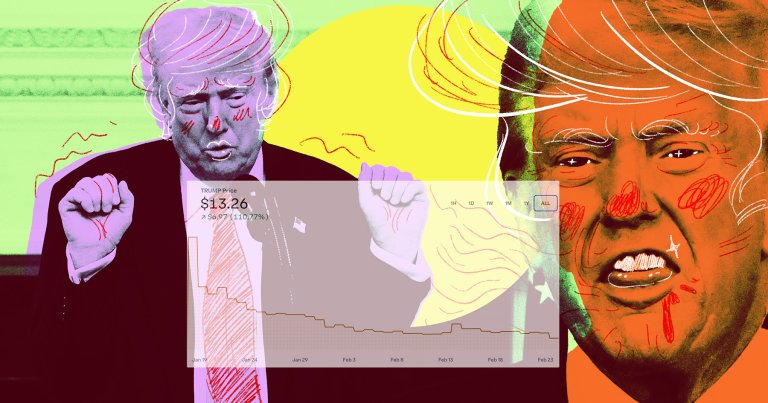
On Tuesday night, $TRUMP fell to a measly $2.87 — its lowest point yet, Decrypt reported — and a staggering 96 percent plummet from its all-time high. By press time, it was down even further to $2.73.
$TRUMP’s ill fortunes come amid a downturn for cryptocurrencies at large, including Bitcoin, which has plummeted by over 38 percent in the past six months. Unlike the presidential meme coin, though, Bitcoin has shown recent signs of potentially recovering some value.
That a sitting president has a meme coin in his name at all is a clear conflict of interest that should be a major scandal in its own right. Adding to the sleaziness of the venture is that it very likely was used to sucker many of Trump’s followers out of their money. An early group of investors who bought the token at dirt cheap prices immediately after it was officially announced cashed out just days later, pocketing nearly $700 million. One who made an account just hours before Trump launched the coin walked away with $109 million.
The sudden sell-offs by the early big money investors led to the coin’s price collapsing, reeking of a common crypto scam called a “rug pull,” in which a schemer hypes up their new coin, convinces people to buy into it to boost its value, and then suddenly sells their stake in it. The schemer makes out with bags of money, while the followers are left with nearly worthless assets.
Whether the Trump family was directly involved in a rug pull, it made gangbusters business, raking in over $100 million in trading fees in just two weeks post-launch. As of January, the Financial Times reported that the $TRUMP coin, and it the First Lady’s $MELANIA that followed, have generated about $427mn in sales and trading fees.
Shutdown infighting shatters GOP unity in critical stretch for Trump

What started as a shutdown face-off between Republicans and Democrats has morphed into a full display of disunity between GOP leaders just months ahead of the midterm elections
Senate Majority Leader John Thune’s decision to leave immigration enforcement funding out of a deal with Democrats to reopen the Department of Homeland Security and the House GOP’s revolt over that deal has shattered the fragile party unity that had been crucial to President Donald Trump’s second term.
Now, Republicans are running Washington during the longest-ever shutdown of DHS with no path out, while their unifier, Trump, is consumed by a Middle East war that threatens even more problems for Congress this year.
Thune, knowing he had to contend with Democrats, cut the only deal he believed was possible to end the shutdown. The Senate GOP leader’s allies insist that he didn’t make the decision unilaterally and that his members agreed by virtue of not stopping the measure. They also point out that Republicans can use a party-line maneuver later on to secure the rest of the funding.
Thune and Johnson have spoken several times since Friday, when the Senate plan to end the shutdown was blocked in humiliating fashion by House Republicans, according to two people familiar with the discussions, though both declined to offer specifics about what was discussed or their plans going forward.
But there are still deep divisions between the two GOP leaders and their conferences, with fulsome bipartisan negotiations virtually nonexistent — raising real questions about whether Republicans can end the shutdown.
Now in a two-week recess, the two Republican-led chambers are deadlocked with both hesitant to cut short their time away from Washington without a clear solution that can make it to Trump’s desk. And Republicans are keenly aware that Democrats — whose votes will be needed for the final deal — see no reason to bargain amid the GOP dysfunction.
It also reveals a deepening schism between the two men, who have until this point navigated occasional tactical differences behind the scenes. Now, Johnson — buoyed by Trump — is leading a public campaign to pressure the Senate back to Washington to push a hardline shutdown strategy, while Thune becomes a target of seething conservative backlash.
“We have got a dilemma. … The Senate has to do their job and help us on this heavy lift,” Johnson said Tuesday on Fox News, in a rare missive directed at his fellow Republicans across the Capitol. “We have to get the government funded, and they are playing games with real people’s lives.”
Johnson, a devout Southern Baptist who mostly avoids disparaging fellow Republicans, has been careful not to criticize Thune directly in public. But privately, he and his fellow House GOP leaders believe Thune botched the negotiations and triggered an intraparty clash that could last through the midterms.
Asked about Thune’s leadership, Rep. Lisa McClain, a member of House leadership, told CNN: “I’d rather not comment on that, but I would suggest the Senate does come back and at least take a vote. That is what they were elected to do.”
Rep. Mike Simpson, a mild-mannered Mormon and 27-year veteran of the House, added to CNN: “I don’t have principled words I can say about it.”
But when pressed about Thune’s push ahead on shutdown talks without consent from House GOP leaders, he added: “It’s never a good idea. I keep telling myself, well, that’s the Senate. I try not to interfere with their business. But it’s questionable, let’s put it that way.”
It’s not just House Republicans who have at times broken with Thune amid the shutdown: Even centrist Sen. Susan Collins declined to put her name on the amendment that Thune introduced last week to eliminate the contentious immigration funding, according to one person familiar with those internal discussions. One of Thune’s most hardline members, Sen. Mike Lee of Utah, has been calling for the Senate to come back into session for days.
Some of Thune’s fellow Senate Republicans, however, have previously acknowledged their leader has been dealing with difficult decisions for months.
“He’s doing good considering the team he’s got,” Republican Sen. Tommy Tuberville said of Thune before the Senate passed the bipartisan DHS deal. “We’re so divided on how to handle certain things and he just got dealt a hand that is very, very tough to control.”
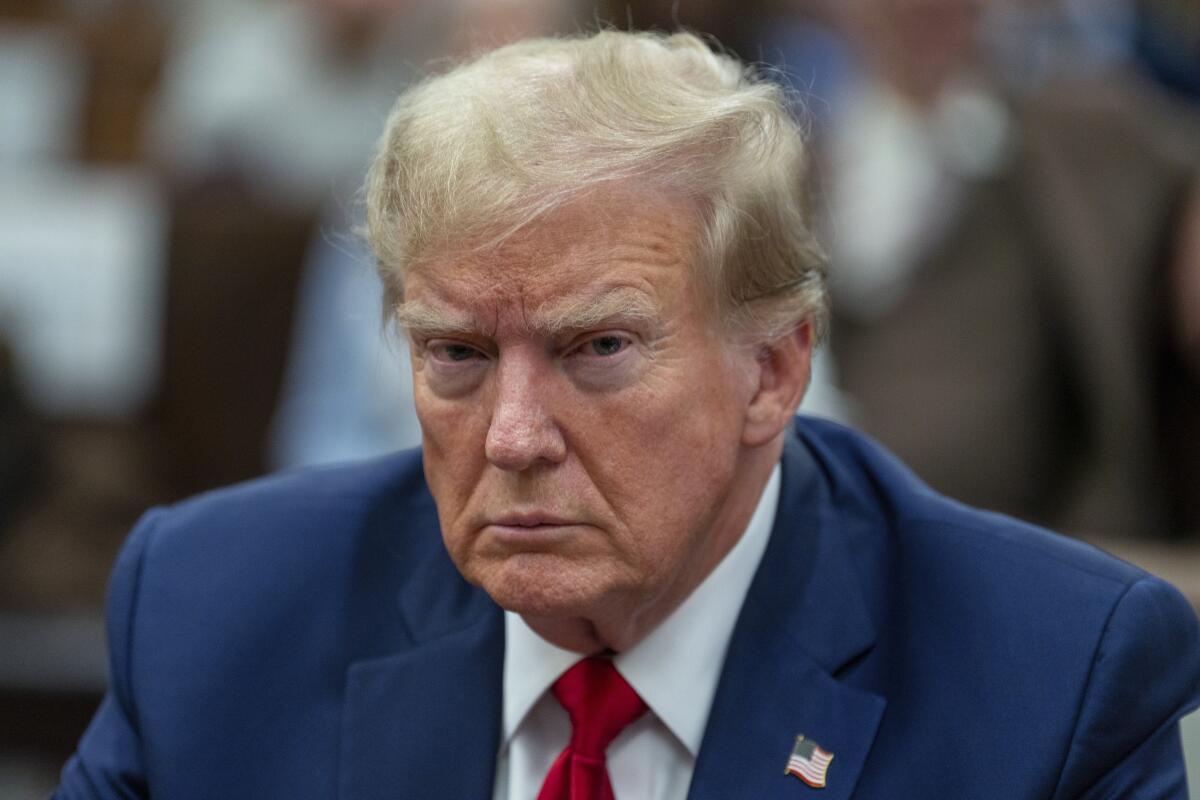
“The thing I would say about John Thune is he’s an honest man, he’s an honest broker and I think that really counts for a lot,” Sen. Josh Hawley said in a recent interview before Thune put the DHS spending bill on the floor. “That is a quality in short supply in this town. I have never had John Thune tell me something that wasn’t true and I never had him make a promise he didn’t keep.”
It’s not just the shutdown. Thune and Johnson — as well as much of the GOP — are on different planets when it comes to what else Congress should tackle in 2026. Johnson has been adamant that Congress should pursue another massive partisan policy bill that could involve major Trump priorities such as a voter ID law before the midterms using a procedure known as reconciliation.
For Johnson, satisfying his right flank is essential for his own survival in leadership. (And he has a lot more GOP hardliners on his side of the Capitol than Thune does.)
But some Senate Republicans have been frustrated that Johnson and hardline conservatives are pushing a sweeping reconciliation plan when the lower chamber barely has a functioning majority. They believe it sets up failure and will only alienate the Trump base come November.
Some Trump officials are aware that jamming another major party-line bill through Congress could end in failure, especially with only months left until the midterms and no clear consensus on what should go into the legislation.
But many around Trump believe they need to give it a shot, eager to show the MAGA base that they’re still fighting for key priorities — and of the belief that Trump’s outsize influence could still be enough to convince lawmakers to line up behind another big bill.
“I was told we couldn’t do the ‘One Big, Beautiful Bill’ from some really smart inside baseball Hill people,” said one Trump adviser. “And they obviously did it.”
Senior Republican lawmakers and aides acknowledge that much of the fury at Thune comes from an insatiable push from conservatives to nuke the Senate’s filibuster and allow the chamber to pass anything they please without Democratic votes. Thune — while far from the only GOP senator who wants to preserve the filibuster — has become the public face of the battle.
Online, Thune has become the latest target for MAGA influencers already upset with him over his refusal to kill the Senate’s filibuster (which he has said repeatedly he doesn’t have the votes to do) to pass the president’s “SAVE America Act” voter ID bill. Some House conservatives have even called on Thune to be replaced, which has virtually no chance of happening given support for the South Dakota lawmaker within his ranks. Senate GOP sources, including conservatives, told CNN that is highly unlikely in the coming months.

Still, Thune is hammered every time he has to negotiate with Democratic colleagues, who are crucial to the 60-vote threshold to end debate and move to a final vote on legislation.
The latest tension between the two GOP leaders indicates trouble ahead as the party stares down a tumultuous few months in which they still have to pass a clean reauthorization of the intelligence community’s spy powers, find a way out of the shutdown, and face pressure to pass another party-line policy bill that will once again force both GOP leaders to operate with almost no defections.
Then there’s a potentially massive funding request from the Pentagon that has already revealed deep divisions among Republicans — and even a rare split with Trump.
While the recent disagreement over funding has been on full display, the president himself has been careful not to target Thune directly.
“I understand John Thune and I understand Mike Johnson,” Trump said Friday. “They want to be sure that people aren’t coming into our country like they have for the last four years. I don’t want to say they’ve ruined it. They made my job a lot harder and now we have it good.”
People inside the White House also still view Thune as a straight shooter and key ally of the president in the Senate, adept at navigating sometimes-conflicting viewpoints even within his own conference.
“It’s hard being the leader because you’ve got to deal with a lot of people and they all have their own egos and they all have their own constituencies,” the Trump adviser said. “No matter what happens, Mike Johnson will still be speaker and even John Thune will probably still leader. Maybe not, but who knows.”
Trump might end his war — but the rest of the world may pay the price

Donald Trump looks like he’s getting ready to just walk away.
The president is telling US allies — who didn’t join his war in Iran because they got no advance notice, didn’t want it and thought it infringed international law — that they’ll be stuck with the consequences.
“Go get your own oil,” he wrote on Truth Social Tuesday, shortly before sources told CNN that the administration can’t promise to restore free navigation through the Strait of Hormuz before declaring mission accomplished.
The president later predicted the war will be “finished” within two to three weeks. “What happens in the Strait, we’re going to have nothing do with,” he told reporters in the Oval Office
Iran has used the choke point at the mouth of the Persian Gulf to halt crucial oil supplies and to hold the global economy hostage. If the war ends with it in control of the critical waterway, it will chalk up a strategic victory.

Amid fresh signs Trump wants the war over, officials seem to be shaping rhetorical cover for him to end it without fixing the aftermath. Defense Secretary Pete Hegseth on Tuesday claimed the US had achieved “regime change” in Iran — even though the country is still ruled by repressive Islamic radicals who despise the US.
The latest administration attempts to redefine success reflect unpalatable choices facing Trump more than a month into the war and the growing pressure of a four-to-six-week deadline officials set for its duration. They follow assertions by the president that “productive” talks are taking place with Iran — although officials in Tehran deny this is the case and there’s no public evidence of diplomatic progress.
Trump has strong domestic reasons for halting the conflict before it inflicts more economic pain on Americans already weary of high prices. As gasoline rose to an average price of $4.06 a gallon on Wednesday, a new CNN poll conducted by SSRS showed that his approval rating on the economy had fallen to 31%.
But ending the war with Iran controlling the strait would be seen internationally as a strategic defeat for the United States. Iran would certainly claim victory and might consider it had reestablished a deterrent to future attacks. And it would likely try to monetize its new position by imposing tolls for tankers transiting the route. This would provide revenues for rebuilding military, missile and even nuclear programs smashed in US and Israeli air attacks.
All this would challenge Trump’s skill at spinning almost anything into a victory. But it might still be a preferable endgame for the president because any attempt to reopen the strait by force would risk heavy US casualties and prolong the war in a way that would further undermine his eroded political authority at home.
Trump can’t escape the consequence of his decisions

Walking away might leave turmoil. But it would be consistent with Trump’s methodology, which in practice has been more effective in destroying status quos than building new systems. It would also extend the America First principle that the country should act at all times within the confines of its exclusive national interests. And it would indulge Trump’s anger at NATO allies he regards as leeching off American security guarantees.
But America doesn’t exist in a vacuum defined by Trump’s rhetoric. He’d struggle to outrun the economic and political reverberations of keeping the strait under the control of a reinvigorated Iran. Trump may be able to create political spin to explain his exit — but the markets are unlikely to be as easy to convince.
“Even though the United States is the world’s leading oil producer, that doesn’t insulate US consumers from oil prices because oil prices are global,” Rosemary Kelanic, director of the Middle East studies program at the Defense Priorities think tank, told Zain Asher on CNN International on Tuesday. “And so everybody in the United States and everybody in the world is affected by this supply shock.”
That economic blow threatens to set off a global recession that would crash onto US shores — possibly months before the midterm elections, in which Democrats hope to score a big win that will help them rein in Trump’s second-term power.
More broadly, the fallout of the Iran war now threatens another consequence: an even deeper fracture in the transatlantic alliance. This would only underscore the need for European allies — and those Canadian Prime Minister Mark Carney calls “middle powers” — to invest more in their own militaries with the understanding that America’s post-World War II security umbrella has become unreliable.
Warning bells reverberated throughout Europe when Secretary of State Marco Rubio, one of the most pro-NATO members of Trump’s inner circle, said on Al Jazeera this week that US allies’ response to the war was “very disappointing” — and hinted Trump would “reexamine” US commitments to them when it ends.
How Europe might pay the price

Allied leaders are learning in the unpredictable age of Trump that they can no longer rely on US security guarantees since an American president appears close to making them conditional on blanket support for his actions.
Some, like Britain, initially withheld permission for the US to use air bases for offensive missions in Iran. Others, like Spain, went much further. As a result, Trump lambasted the “special relationship” with London and threatened to cut off all trade with Madrid. He told Britain’s The Telegraph that he was considering a withdrawal from NATO and called the alliance a “paper tiger,” adding that Russian President Vladimir Putin shares his view.
Trump put European leaders in an impossible position. His year of berating allies, including his demands that Denmark hand over Greenland; tariff assaults; and disdain for the sacrifices of America’s friends in post-9/11 wars meant they had little room to both help him and save their own political careers.
But staying out of the war won’t spare them from paying its costs.
High energy prices and rising inflation threaten to crush fragile economies and cause political blowback among electorates to already-weak centrist governments in Europe. There’s talk of rationing gasoline and diesel already in some EU nations. And there are fears on the continent that a collapse of central government authority in Tehran could trigger yet another mass refugee exodus towards its borders and test fiscal and cultural fault lines.
And it’s not credible that these countries could simply — in Trump’s words — go get their own oil. Slimmed-down European militaries have been exposed by the war. It took several weeks for Britain’s Royal Navy to get an anti-missile destroyer stationed off Cyprus to protect UK assets. France managed to dispatch an aircraft carrier battle group to look after its interests and those of Middle East allies. But without the support of the US, there’s no chance NATO powers could open the strait and keep it open. Even the mighty US Navy currently considers it too dangerous to venture in range of Iranian drones and missiles.
As always with Trump, it’s wise not to take everything he says at face value. Indications the US may walk away from the war came a day after he warned that he’d obliterate Iranian electrical plants and even desalination facilities in a violent escalation of the war if Tehran failed to satisfy his demands for peace.
Trump’s public venting is sometimes a ruse to force the hands of weaker counterparts. Rubio hinted that this might be the case when he said on Friday that “countries in Asia and all over the world have a lot at stake and should contribute greatly” to an effort to reopen the Strait of Hormuz.
There may be no clear off-ramp for Iran and the US — but maybe there’s one for US allies in their showdown with Trump. Europe does have the capacity to be useful. Some countries have minesweeping capabilities that the US lacks. France has said it would be willing to join an international mission with other navies to protect shipping through the strait — but only after fighting stops.
“I think they’re still working to prevent these differences with the United States on Iran from causing a permanent rupture to the transatlantic relationship,” Stephen Flanagan, a former senior director for defense policy and strategy at the National Security Council, said at a Middle East Institute briefing Tuesday. “But this has become difficult every day in the face of Trump’s withering criticisms of how the Europeans have responded so far.”
The US seems to want more.
“(Trump is) pointing out this is an international waterway that we use less than most; in fact, dramatically less than most. So the world ought pay attention and be prepared to stand up,” Defense Secretary Pete Hegseth said Tuesday.
But there’s no appetite in Europe for being dragged into yet another American war in the Middle East with what critics regard as a questionable rationale and no path to a better situation after the fighting.
“What does (…) Donald Trump expect a handful or two handfuls of European frigates to do in the Strait of Hormuz that the powerful US Navy cannot do?” German Defense Minister Boris Pistorius said last month.
“This is not our war; we have not started it.”
But this position will not spare allies from the war’s fallout — a reality that reflects what is becoming a defining characteristic of Trump’s second term.
Hundreds of millions of people from Asia to Europe and Africa to the Middle East didn’t vote for him and have no say in what he does.
But his decisions are changing their lives in profound ways nonetheless.
Trump suggests US is considering leaving ‘paper tiger’ NATO

President Donald Trump suggested in an interview with a British newspaper that he’s considering withdrawing the US from NATO after repeatedly criticizing a lack of support from members for the Iran war.
Asked by the right-leaning Telegraph if he would reconsider the US’ membership of NATO after the war, Trump said: “Oh yes, I would say (it’s) beyond reconsideration… I was never swayed by NATO. I always knew they were a paper tiger, and (Russian President Vladimir) Putin knows that too, by the way.”
Members of NATO, a defensive military alliance, have been reluctant to deploy military assets to reopen the Strait of Hormuz, a crucial oil shipping lane that Iran effectively closed in response to the US and Israel attacks.
Trump’s comments, reported Wednesday, are the latest in a series of rebukes he has issued to NATO members over not “being there” for the US. On Tuesday, he told countries struggling to source jet fuel due to the closure of the Strait of Hormuz to “build up some delayed courage, go to the Strait, and just TAKE IT.”
“You’ll have to start learning how to fight for yourself, the U.S.A. won’t be there to help you anymore, just like you weren’t there for us,” the president wrote on Truth Social.
Trump’s position has been puzzling to members of NATO, which is an alliance based on the principle of collective defense. Article 5, which states that an attack on one is an attack on all, has only been invoked once in the alliance’s history, following the September 11, 2001, attacks on the US. More than 1,100 non-US troops were killed after allies joined the US’ ensuing war in Afghanistan.
Despite those allied efforts, Trump has long questioned whether NATO allies would “be there” if the US “ever needed them,” baselessly claiming in January that NATO troops “stayed a little back” from the frontlines in Afghanistan. The president has continued to voice skepticism about the alliance since the US and Israel launched the war against Iran on February 28.
“Beyond not being there, it was actually hard to believe. And I didn’t do a big sale. I just said, ‘Hey,’ you know, I didn’t insist too much. I just think it should be automatic,” Trump told The Telegraph.
“We’ve been there automatically, including Ukraine,” he said. “Ukraine wasn’t our problem. It was a test, and we were there for them, and we would always have been there for them. They weren’t there for us.”
Although the US provides some military intelligence to Ukraine and allows Europe to purchase American weapons on Kyiv’s behalf, the US government has not authorized a new package of military or financial support to Ukraine since Joe Biden’s presidency.
In his recent broadsides against NATO, Trump has singled out British Prime Minister Keir Starmer. Starmer initially refused the president’s request to use British military bases in offensive operations against Iran, which Britain had judged to be illegal. Starmer did, however, join the defense against Iran’s retaliation after British military assets in the Middle East came under attack.
In the Telegraph interview, Trump mocked Britain’s fleet of warships, saying: “You don’t even have a navy. You’re too old and had aircraft carriers that didn’t work.”
“I’m not going to tell him what to do. He can do whatever he wants. It doesn’t matter. All Starmer wants is costly windmills that are driving your energy prices through the roof,” Trump added, referring to clean energy projects.
Asked about Trump’s latest comments, Starmer stressed that NATO remains “the single most effective military alliance the world has ever seen.” He reiterated that Britain will not “get dragged into” the war with Iran.
Related Articles


Featured Posts

Abandoned Dog Refuses To Leave The Doorstep Of Her Old Home, Hoping Her Owners Would Take Her Back


:max_bytes(150000):strip_icc():focal(658x345:660x347):format(webp)/nacho-the-dog-tout-10212024-027bc33d675c4321b7d23a1c9b0d1188.jpg?resize=750,500&ssl=1 "Woman Adopts Dog She Fostered Years Earlier After He’s Found as a Stray: ‘I Knew I Had to Get Him’ (Exclusive)")



:max_bytes(150000):strip_icc():focal(589x277:591x279)/jennifer-lopez-wwhl-101625-8d8acae71f4149c79b5e8648ea25332b.jpg?resize=1500,1000&ssl=1 "Jennifer Lopez Reveals Her Favorite On-Screen Smooch, Calls the Actor the ‘Best Kisser’")

:max_bytes(150000):strip_icc():focal(749x0:751x2):format(webp)/baby-gets-diagnosed-with-rare-mitochondrial-disease-102925-9-3e855762e0a648ddaaa5b85eb3787ffc.jpg?resize=750,500&ssl=1 "Mom Learns Baby Is One of 6 Born with Rare Disease — and All 5 Others Are Dead. Now, She’s ‘Terrified’ for the Future (Exclusive)")


:max_bytes(150000):strip_icc():focal(749x0:751x2):format(webp)/tout-Underweight-Dog-050426-c32e0d4b6e5447f1a7f1141e4080398c.jpg?resize=750,500&ssl=1 "Underweight Stray Dog, with ‘Dangerously Low’ Body Temperature, Rescued and Given New Name While Being Nursed to Health")



:max_bytes(150000):strip_icc():focal(745x234:747x236):format(webp)/Bristal-Brewster-1-050726-7115d79c6c614189aefa39b2e1a4b783.jpg?resize=750,500&ssl=1 "Parents Notice Their Toddler’s Sudden Limp. An MRI Scan Revealed the Devastating Reason (Exclusive)")

:max_bytes(150000):strip_icc():focal(749x0:751x2)/jennifer-aniston-111225-c037a077dd3043178ee27f4038312cd6.jpg?resize=1500,1000&ssl=1 "Jennifer Aniston Overcomes the Pain of Infertility")



:max_bytes(150000):strip_icc():focal(764x9:766x11)/Will-Smith-Says-Hes-Lost-Sleep-Over-Potentially-Penalizing-His-Emancipation-Crew-After-Oscars-Slap-112922-2b5ef96896d34b7e8c33f4a36aee6cf4.jpg?resize=1500,1000&ssl=1 "Will Smith Sued")
:max_bytes(150000):strip_icc():focal(728x329:730x331)/michael-douglas-wall-street-020226-2-f626de6e6c884382ae5e9697d94db977.jpg?resize=1500,1000&ssl=1 "Why Is Michael Douglas Halting His Career Following Tongue Cancer Treatment?")